
AI in the Workplace and the Enduring Value of Human Work
CLA faculty bring ethical, human and historical perspectives to the AI conversation that the technology industry alone cannot. Learn how five CLA faculty are preparing students to navigate an AI-shaped workforce with sound judgment, not just AI skills.
Automating Drudgery Without Outsourcing Understanding
Andrew Fricker | Associate Professor of Geography, Social Sciences
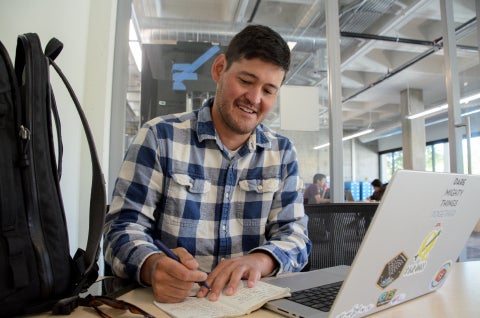
Andrew Fricker applies AI to satellite imagery, machine learning models and computer vision. His lab built custom models for post-wildfire building damage assessment and uses pre-trained models to analyze tree canopy data at scale.
For Fricker, some uses of AI are easy to defend. When a task is repetitive and draining, automation frees people to do more meaningful work. One of his students has been working with the City of San José to geo-reference thousands of legacy engineering maps, aligning old paper diagrams with geographic space. AI makes a real difference there, not because it replaces expertise but because it removes the kind of repetition that makes people resent the work.
Still, Fricker draws a clear line between automating a process and outsourcing understanding. AI can generate code, run analysis and sort through large datasets, but it cannot decide what question is worth asking. It cannot replace the judgment needed to know whether a result is real, useful or misleading.
That is where he sees the risk for students. A student can use AI to produce a project proposal that looks impressive without understanding the work. The document may pass at first glance, but the learning has been bypassed. The same problem follows graduates into the workplace. “You think you have an answer, but you don't know how to fact-check it,” Fricker said.
He believes that in an AI-assisted workplace, the low-level technical task may become easier to automate, while knowing what questions to ask will become more important, a shift that may favor liberal arts students with strong critical thinking skills.
The work that requires a human in the room
Kim Bisheff | Assistant Professor, Journalism

Kim Bisheff's perspective on AI is shaped by her field’s ongoing need to ask, “What can computers do, and what can only humans do?”
Her answer is precise. AI is well-suited to tasks the user can verify: aggregating research, organizing source materials, parsing dense documents. She uses it that way herself to make source documents searchable and to build custom draft-assessment tools trained on her department's rubric. That tool flags sourcing issues, bias and narrative problems but deliberately withholds corrections. Students must decide how to fix what it finds. The design is intentional: AI surfaces the problem; the human solves it.
What AI can’t do, in her field, is the most important part of the job. Journalism runs on relationships with sources, presence in a room and the kind of trust that makes a family agree to talk about something difficult with a stranger. “AI can summarize a City Council meeting transcript, but it can’t describe the mood in the room or talk with community members about how government decisions affect their lives,” Bisheff said.
Bisheff also raises the issue of data privacy. Most large language models incorporate user input into their training data, and most users do not read the privacy policies. In a journalism context, that risk is especially acute. Source information, unpublished notes and sensitive interviews can all be absorbed into a system the journalist does not control.
She points to a cultural countertrend she finds encouraging. Students in her media innovation courses have been turning toward in-person, analog solutions: news quizzes played in real rooms, moderated community dinners, direct conversation. In a media environment saturated with AI-generated content, proof of human origin is becoming its own form of value.
Writing is Not Just Output. It is Thinking.
Krista Speicher Sarraf | Associate Professor, English; Director, Technical and Professional Communication Program

For Krista Speicher Sarraf, writing is thinking. Drafting a memo, composing a difficult email or working through a proposal forces a person to clarify their own reasoning. It makes them slow down, confront ambiguity and decide what they mean. If AI takes over that process, it removes the cognitive work that produces understanding.
When writers approach these tools as creative collaborators, Sarraf sees useful applications, especially when the task is predictable or pattern-based — or when the reader is a large language model, as is increasingly the case on the job market. AI can show someone what a familiar professional genre looks like. For a student who has never written a formal memo, seeing a standard example can be helpful. For those learning a language, AI tools may ease the technical aspects of writing so the writer can focus on ideas.
However, these tools can also erase the writer’s unique voice. And when the stakes involve tone, relationship or judgment — as is often the case — she would still ask a human colleague for feedback over a chatbot. A sensitive message is not successful because it is grammatically correct. It is successful because it resonates with another person.
“AI can generate clean content with few grammatical errors, but we risk equating convention with effectiveness and connection,” Sarraf said.
She is especially concerned about what over-reliance does to a writer's relationship with their own voice. When people constantly compare their drafts to polished AI output, they may begin to assume the machine's version is better, simply because the text looks polished. Over time, that weakens not only confidence and judgment but authenticity and language diversity.
The solution, she argues, looks a lot like a CLA-style education: ethical judgment to weigh the implications of using AI tools, critical thinking to evaluate AI output, creative thinking to interpret ideas in new ways and enough trust in one's own memories, stories and lived experiences to communicate with other humans in ways a large language model cannot.
In an AI-focused workplace, knowing whether and how to use generative AI tools is a skill in itself. One challenge for writers is continuing to trust their own perspectives, experiences and problem-solving abilities. Another is relying on intuition and judgment while remaining vulnerable and creative enough to connect with readers in new ways.
Asking What AI Costs Before Asking What it Can Do
Matt Harsh | Professor, Interdisciplinary Studies in Liberal Arts (ISLA) and Science, Technology and Society
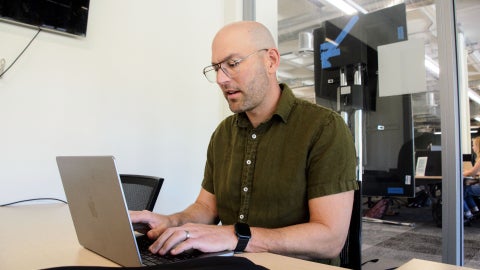
Matt Harsh sees the rise of generative AI as providing a powerful teaching moment. In his classes, historical examples of technology and power feel immediately relevant. When students encounter the case of Robert Moses, the New York city planner whose parkway bridges were built too low for public buses, effectively blocking Black and low-income residents from reaching the beaches, they connect it instantly to how algorithms can produce discriminatory outcomes by design or by training.
Harsh worries that colleges, companies and the public repeat the language of tech firms without questioning it. When every new release is described as inevitable, people end up building the future that tech companies predicted simply by echoing it with their choices of how they use, or do not use, those products.
His deeper concern is what remains hidden behind the clean interface. AI depends on enormous amounts of energy, water, mining and human labor, including content moderators in East Africa who are exposed to disturbing material so the rest of the internet feels safe. AI may feel weightless to the user, but it carries real costs that are rarely part of the conversation.
For students entering the workforce, Harsh sees real opportunity. Small and mid-size organizations are often trying to figure out what to do with AI, and young employees may be asked to lead that conversation. “If our graduates come out with a real critical, nuanced understanding of the benefits and harms of AI, I think they could have a lot of power within those kinds of organizations,” Harsh said.
The first question, he argues, is not what task to hand off to AI. It is whether AI should be used at all. If the benefit is high enough, such as in cancer research, the answer may be yes. If the goal is only to save an hour summarizing a document, it deserves more scrutiny.
Protecting the Work Where the Process is the Point
Keith Abney | Lecturer, Philosophy

Keith Abney, co-editor of “Robot Ethics” and “Robot Ethics 2.0,” has been thinking about artificial intelligence and machine ethics long before generative AI became a topic of daily conversation.
The question he thinks is most often missed is distribution. AI may increase productivity, but the benefits are rarely shared equally. A small number of companies may capture enormous gains while workers, smaller firms and communities lose out. In that sense, AI is not only a technical development. It is an economic and political one.
He is also concerned about what AI does to the information environment. Even if AI produces more accurate information, it can also produce far more inaccurate information. The result is not necessarily more knowledge. It may be more confusion, more noise and a harder time understanding what is true.
Abney pushes back on assumptions about which jobs are most vulnerable. Work people once considered safe because it required education, including legal discovery, radiology and copywriting, can be easier to automate than physical labor. If a job is measured primarily by its output, AI can compete with it.
What remains more deeply human, he argues, is work where the process matters as much as the product. That distinction matters in education. If students ask AI to produce the draft, they end up with something that looks like thinking without having done the thinking.
“The kind of jobs best suited for humans in the near future are those where the process of doing the work is the point, not just the output,” Abney said.
Abney argues that AI has specific beneficial applications. He has used it himself to ask for critical feedback on a draft and received useful insights, “but if I just asked the AI to produce the draft itself, I wouldn't have learned anything at all.”
Photo credits: Rintaro Sato.
More about AIThis feature represents individual faculty members' current opinions, as part of a continuing AI discussion series. Hear from other faculty experts about how they used AI in the classroom in the 2025 Impact Magazine issue.


